
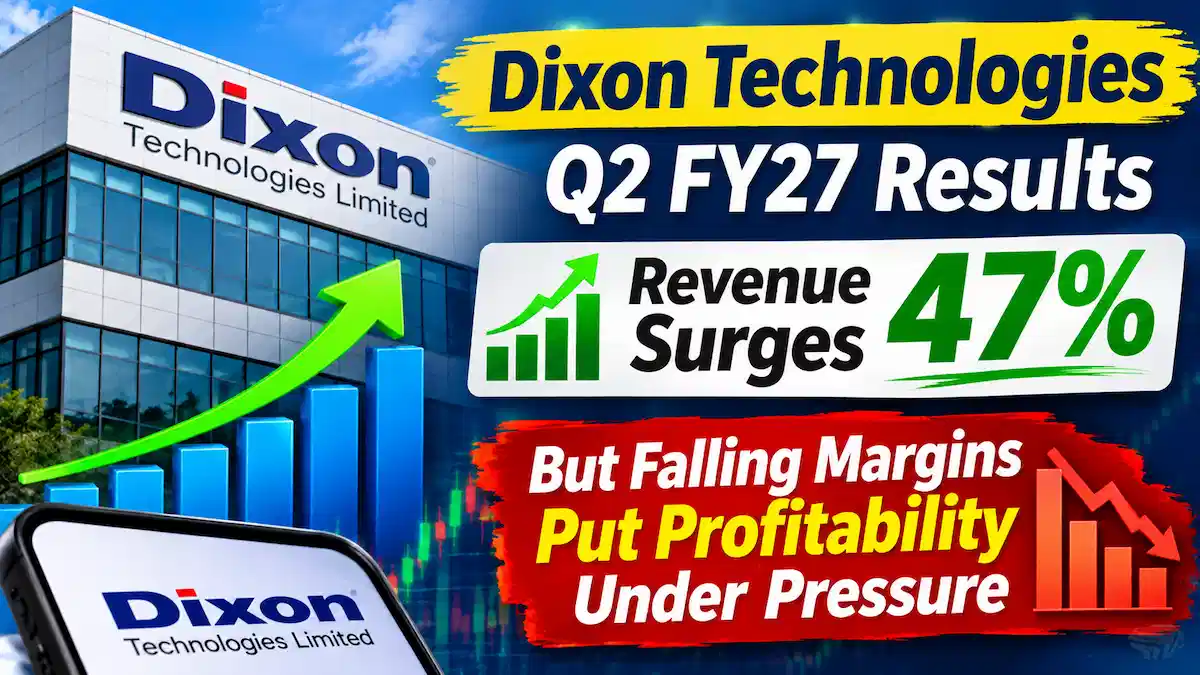
The company delivered a strong revenue performance in the second quarter of FY27, supported by higher smartphone realisations, expanding manufacturing operations and growing opportunities in IT hardware. However, rising input costs, the expiry of production-linked incentive benefits and pressure on operating margins have made profitability the biggest concern.
With new manufacturing opportunities emerging across several electronics categories, Dixon Technologies is entering an important phase of its growth journey.
Dixon Technologies Q2 FY27 Results: Revenue Jumps 47%
Dixon Technologies reported consolidated revenue from operations of approximately ₹21,794 crore in Q2 FY27, compared with ₹14,855 crore in the corresponding quarter last year. This represents year-on-year growth of nearly 47%.
The strong performance highlights the company’s expanding manufacturing scale and its ability to benefit from India’s growing electronics production ecosystem.
However, the profit numbers presented a different picture. Reported EBITDA declined around 37% year-on-year to approximately ₹666 crore, while reported consolidated net profit fell nearly 45% to ₹411 crore.
The previous year’s results included substantial other income and fair-value gains, making the year-on-year profit comparison less straightforward. Even after considering adjusted earnings, operating margins remain an important area to watch.
Dixon Technologies Q2 FY27 Results Why Profitability Has Become the Biggest Challenge
Despite impressive revenue growth, Dixon’s operating performance faced pressure during the September quarter.
Its EBITDA margin declined to approximately 2.7% from 3.8% in Q2 FY26. Higher memory prices, raw material expenses and the expiry of mobile production-linked incentive benefits contributed to the pressure.
The company operates in a competitive manufacturing industry where even small changes in costs can significantly affect profitability.
Rising smartphone component prices have also increased the value of products manufactured by Dixon. However, higher selling prices do not automatically translate into better margins.
Investors will therefore want to see whether the company can improve operational efficiency, manage input costs and increase the contribution of higher-value manufacturing activities.
Dixon Technologies Q2 FY27 Results Smartphone Manufacturing Remains a Major Growth Driver
Mobile manufacturing continues to play a crucial role in Dixon Technologies’ expansion strategy.
Interestingly, the company’s smartphone revenue growth has been stronger than its volume growth. Higher memory prices increased average selling prices, while smartphone volumes remained under pressure.
According to brokerage commentary, mobile volumes declined around 7% year-on-year to approximately 9.5 million units during the quarter.
Dixon has maintained its FY27 mobile volume guidance of 33–34 million units, excluding the Vivo joint venture.
The upcoming integration of Vivo’s manufacturing operations could provide another significant opportunity. The company is targeting mobile volumes of 55–60 million units in FY28, including Vivo.
If the planned expansion progresses successfully, it could strengthen Dixon’s position in India’s smartphone manufacturing market.
Dixon Technologies Q2 FY27 Results IT Hardware, Displays and Exports Offer New Opportunities
Dixon is not depending entirely on smartphones for its future growth.
The company is expanding into several electronics manufacturing categories, including:
-
IT hardware, including laptops and tablets.
-
Display manufacturing and component production.
-
Optical components and camera modules.
-
Telecom and networking equipment.
-
Smartphone exports and additional customer partnerships.
IT hardware is particularly important because it offers Dixon another avenue to increase manufacturing scale.
The company expects IT hardware revenue of approximately ₹6,000–6,500 crore in FY27, with ambitions to expand the business substantially over the coming years.
Its investments in backward integration and component manufacturing could also help improve cost efficiency and reduce dependence on external suppliers.
Dixon Technologies Q2 FY27 Results What Should Investors Watch After Q2 FY27?
Dixon’s future performance will depend on how successfully it balances expansion with profitability.
The company has significant opportunities in India’s electronics manufacturing sector, but investors cannot ignore the risks associated with rising costs, smartphone demand and execution delays.
Some important factors to monitor include:
-
Improvement in EBITDA margins over the coming quarters.
-
Successful integration of the Vivo joint venture.
-
Growth in IT hardware and component manufacturing.
-
Better smartphone volume performance.
-
Benefits from backward integration and new customer additions.
Brokerage opinions remain divided. While some analysts see opportunities from expansion and new manufacturing partnerships, others remain concerned about margin pressure and slowing earnings growth.
For Dixon Technologies, the next stage is about more than increasing revenue. The company must demonstrate that its expanding manufacturing business can generate consistent earnings growth. Its long-term opportunity remains attractive, but sustainable profitability will ultimately determine how investors value its growth story.
FAQs
1. What was Dixon Technologies' revenue in Q2 FY27?
Dixon Technologies reported consolidated revenue from operations of approximately ₹21,794 crore in Q2 FY27, registering nearly 47% year-on-year growth.
2. Why did Dixon Technologies' profit decline despite revenue growth?
Profitability faced pressure due to higher memory and raw material costs, the expiry of mobile PLI benefits and lower other income compared with the previous year.
3. What are the major growth drivers for Dixon Technologies in FY27 and FY28?
Major growth drivers include smartphone manufacturing, the Vivo joint venture, IT hardware, display manufacturing, component production, exports and backward integration. Is this conversation helpful so far?











Sudhanshu is the author of XYZ News Live and has over 2 years of experience in digital content writing. His focus is on presenting news and important information in a simple, clear, and accessible language for readers.
1 thought on “Dixon Technologies Q2 FY27 Results: Revenue Surges 47%, But Falling Margins Put Profitability Under Pressure”