


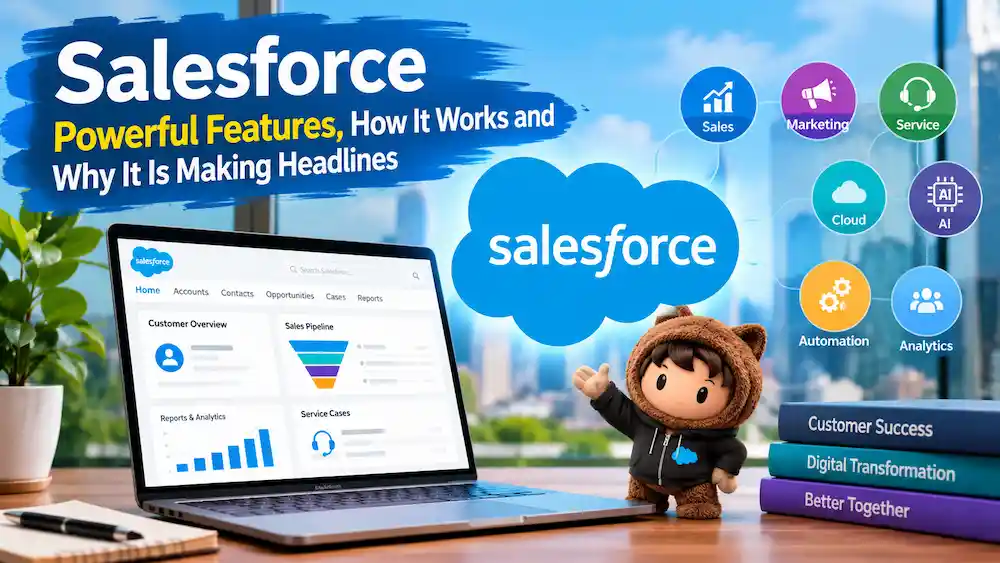
Salesforce is a cloud-based Customer Relationship Management (CRM) platform that helps businesses manage customer information, sales, marketing, and service operations in one connected environment. Rather than scattering customer data across disconnected systems, companies use Salesforce to give sales, support, and marketing teams a shared view of every customer relationship.

Key Highlights
- Salesforce is a cloud-based CRM platform that helps businesses manage customers, sales, marketing and service operations.
- Its AI-powered tools, including Agentforce, are designed to automate tasks and support employees across different business functions.
- The platform brings customer data, analytics and automation together, helping companies improve workflow visibility and customer engagement.
- Recent developments around Agentforce and AIforce highlight Salesforce’s growing focus on AI-driven business solutions.
Also Read: LEAP India IPO Debut: KKR-Backed Company Falls in Trading Debut, Valued at $725 Million
How It Works
At its core, Salesforce lets a sales representative track a potential deal’s progress, lets customer service staff pull up a customer’s history while handling a case, and lets marketing teams use that same data to build targeted campaigns. Because everything sits in one cloud-based system, teams aren’t working from isolated information — they’re working from a common source of truth.

Core Features
- Sales management: tracking leads, opportunities, and pipeline stages
- Customer service: managing cases and customer histories, with AI tools that can summarise cases and draft responses
- Marketing: using customer data to personalise campaigns and track engagement
- Analytics: turning collected data into reporting and performance insights
- Automation: reducing manual work by automating repetitive workflows
- Cloud access: letting authorised users reach business data and applications from supported devices anywhere
Why Salesforce Is in the News
Salesforce’s recent attention centres on its push into agentic AI. According to the company, its Agentforce platform is built to create AI agents that go beyond answering simple questions — reasoning through tasks like customer service requests, sales follow-ups, employee support queries, and appointment scheduling, and handing off to a human employee when needed. (Note: since this “reasoning” claim comes directly from Salesforce’s own positioning, it’s worth treating as a company statement rather than an independently verified capability.)
At its Dreamforce event in September 2026, Salesforce announced “AIforce” — described by the company as a new interface layer meant to make its data, workflows, business logic, and AI tools accessible across different interfaces, while maintaining data security, permissions, and governance. Alongside this, Salesforce expanded its Agentforce lineup with agents aimed at sales, service, commerce, and workforce-related tasks.


Separately, Snap has announced enterprise-focused “Specs” augmented reality glasses designed to integrate with Salesforce’s Agentforce platform for workplace use — a sign that agentic AI tools are beginning to extend beyond conventional office software into wearable devices.
[Editor’s note: The AIforce announcement and the Snap–Agentforce integration are specific, recent claims. Before publishing, these should be verified against Salesforce’s official press release and Snap’s announcement, and linked/cited directly, since no primary source was provided in the original draft.]
What This Means for Businesses
Salesforce positions this AI expansion as a way to help companies handle routine, repetitive interactions automatically, freeing employees for work that needs human judgement. That’s a reasonable expectation for automation generally, but it’s also the company’s own framing of the benefit — actual results will depend on how well a business integrates the platform with its existing workflows and data.
Before adopting a platform of this scale, companies still need to weigh implementation cost, employee training, data governance requirements, and how much customisation their workflows actually need. These aren’t small considerations — CRM rollouts commonly succeed or fail based on execution, not just the feature set.
Bottom Line
Salesforce has moved well past being a system for simply storing customer records — it now bundles analytics, automation, and increasingly assertive AI agents into one platform. The more relevant question for businesses evaluating it isn’t whether AI is on offer, but whether it can be integrated with trustworthy data and existing decision-making processes without adding unnecessary complexity. That integration question — not the AI headlines themselves — is likely to shape how well Agentforce and AIforce actually perform once companies put them to real use
FAQs
1. What is Salesforce?
Salesforce is a cloud-based Customer Relationship Management (CRM) platform that helps businesses manage customer information, sales, marketing, and service operations within a connected environment.
2. What is Salesforce's Agentforce?
Agentforce is Salesforce's AI platform that creates AI agents capable of executing tasks through reasoning—such as customer service requests, sales follow-ups, employee support, and appointment scheduling—rather than simply answering questions.
3. Is Salesforce useful for small businesses as well?
The article does not provide information specific to company size, but the platform's core objective is to centralize customer data for businesses of any size and enhance visibility across departments.
4. Will Salesforce's AI agents replace humans?
According to the article, Salesforce claims that its agents hand over tasks to human employees when necessary—meaning the objective is not to replace humans, but to automate routine work and free up employees' time for tasks requiring judgment.
Disclaimer
This article is for informational purposes only, based on publicly available sources at the time of writing. Details about Salesforce’s AIforce, Agentforce, and related announcements have not been independently verified — please refer to Salesforce’s official channels for the latest, accurate information. This is not professional or business advice.














Sudhanshu is the author of XYZ News Live and has over 2 years of experience in digital content writing. His focus is on presenting news and important information in a simple, clear, and accessible language for readers.