


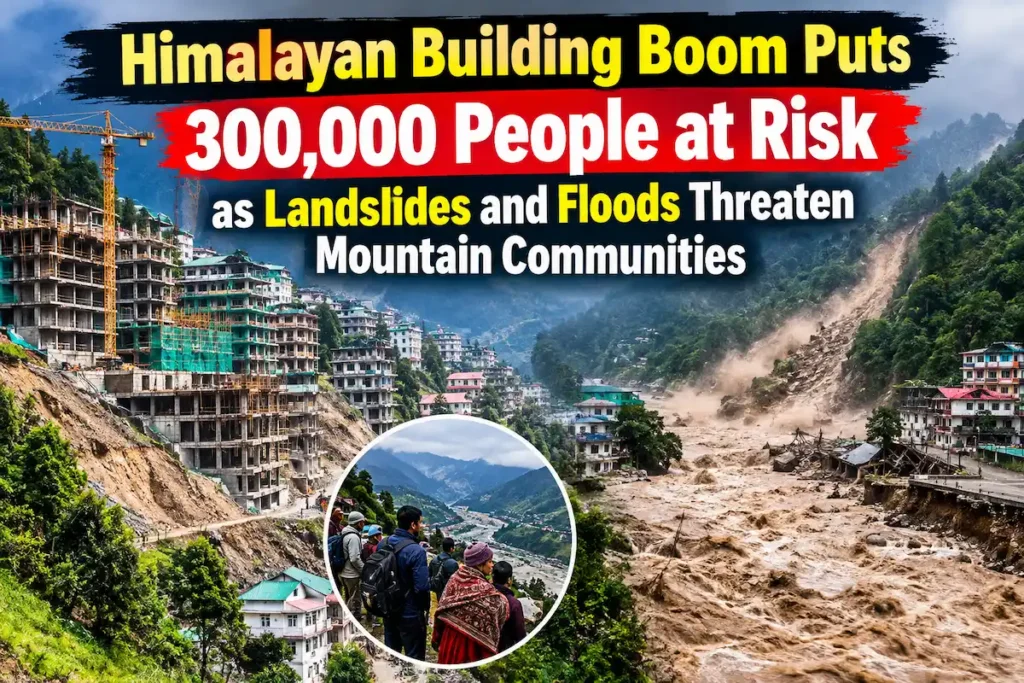
Himalayan Building Boom Raises Disaster Concerns
A rapid construction boom across the Himalayas is raising serious concerns about the safety of people living in one of the world’s most fragile mountain regions. Around 300,000 people are reported to be potentially exposed to Himalayan disasters as expanding settlements, roads, hotels and other infrastructure increase pressure on unstable mountain slopes.
The Himalayas are home to millions of people and support major rivers that provide water to communities across South Asia. However, the region is also vulnerable to earthquakes, landslides, flash floods and sudden glacial lake outbursts. As development pushes deeper into mountain valleys, the risks facing residents are becoming harder to ignore.
Himalayan Building Boom Why Construction Is Increasing the Risk
Growing tourism, expanding towns and demand for better transport have accelerated construction across several Himalayan states and neighbouring mountain regions. New roads, resorts, residential buildings and commercial projects are changing landscapes that have developed over thousands of years.
Construction can increase disaster risks when hillsides are cut without adequate slope protection, natural drainage channels are blocked or buildings are placed on unstable ground. Removing vegetation and disturbing soil can also make slopes more vulnerable to heavy rainfall.
Not every construction project creates danger, but development without proper geological assessments and drainage planning can leave communities exposed when extreme weather strikes.
Himalayan Building Boom Climate Change Is Making Mountain Hazards More Dangerous
The Himalayas are particularly sensitive to rising temperatures and changing rainfall patterns. Melting glaciers, unstable glacial lakes and intense rainfall can combine to create dangerous conditions in mountain valleys.
Cloudbursts can send large volumes of water and debris downhill within minutes. Landslides may bury roads, damage houses and cut off entire villages from emergency services. In some locations, the collapse of natural barriers around glacial lakes can trigger sudden floods.
Climate change does not explain every Himalayan disaster. Local construction practices, land-use decisions, deforestation and the condition of drainage systems also influence how severely communities are affected.

Himalayan Building Boom Local Communities Face the Greatest Consequences
For people living in the mountains, the danger is not limited to damaged buildings. A landslide can destroy farmland, interrupt drinking-water supplies and prevent children from reaching schools. When roads are blocked, ambulances and rescue teams may struggle to reach affected settlements.
Tourism-dependent families and small businesses can also lose their livelihoods when disasters damage hotels, markets and transport links.
The reported figure of 300,000 people highlights the potential scale of exposure, although the precise locations, assessment period and methodology behind that estimate are important for understanding who faces the greatest risk.
Himalayan Building Boom Better Planning Could Prevent Future Tragedies
Experts and disaster-management agencies have repeatedly stressed the importance of development that accounts for local geological conditions. Mountain construction requires different safeguards from those used on stable plains.
Key measures include:
- Conducting geological and landslide-risk assessments before approving projects.
- Avoiding construction in flood channels and highly unstable areas.
- Improving storm-water drainage and slope protection.
- Protecting forests and natural waterways wherever possible.
- Installing early-warning systems and preparing evacuation routes.
- Enforcing building standards and monitoring high-risk construction sites.
Authorities also need to communicate risks clearly so residents can make informed decisions about where they live and work.
Himalayan Building Boom Can Himalayan Development Become Safer?
The challenge is not to stop all development, but to ensure that progress does not come at the cost of human safety. Mountain communities need reliable roads, housing, healthcare and employment. However, these benefits are difficult to sustain if infrastructure is built without accounting for floods, earthquakes and unstable slopes.
Governments, engineers, local communities and environmental specialists must work together to identify dangerous locations and establish stricter planning rules. Existing settlements also need risk assessments, emergency training and reliable warning systems.
With the right safeguards, development can support mountain communities without unnecessarily increasing their exposure to natural hazards. Without them, the growing construction boom could leave thousands of families facing disasters that better planning might have helped prevent.
FAQs
1. Why are 300,000 people potentially at risk from Himalayan disasters?
The reported figure relates to potential exposure to mountain hazards as development expands into vulnerable areas. The exact level of risk depends on the locations covered and the assessment used to calculate the estimate.
2. Which natural disasters are common in the Himalayas?
The region faces landslides, flash floods, cloudbursts, earthquakes and glacial lake outburst floods. Heavy rainfall, unstable slopes and changing climate conditions can increase the severity of some events.
3. How can construction-related disasters be reduced in the Himalayas?
Authorities can reduce risks through geological surveys, safer building locations, effective drainage, slope stabilisation, forest protection, early-warning systems and strict enforcement of construction regulations.














Sudhanshu is the author of XYZ News Live and has over 2 years of experience in digital content writing. His focus is on presenting news and important information in a simple, clear, and accessible language for readers.