


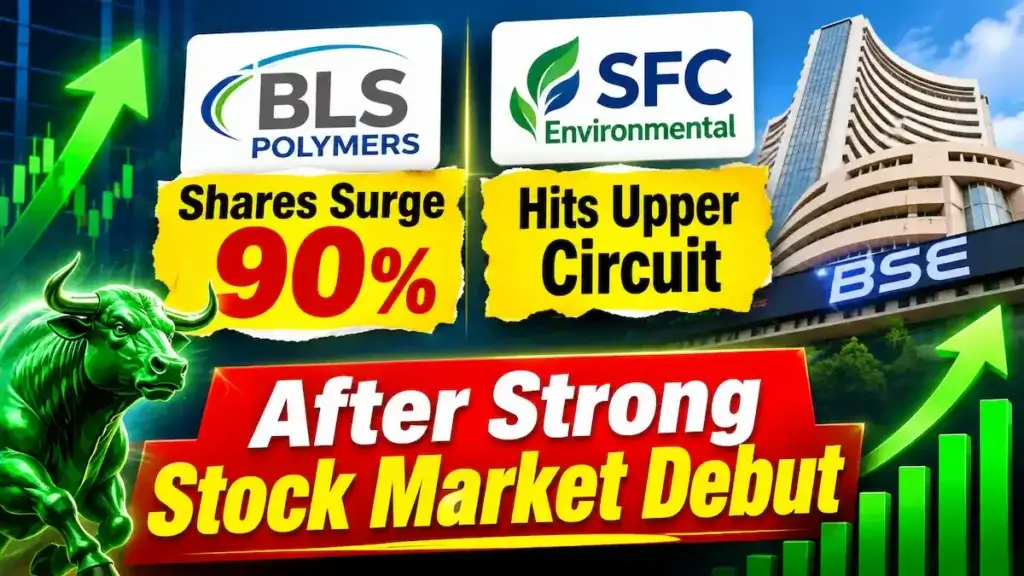
The strong performance highlighted investor enthusiasm for newly listed companies, particularly after both IPOs received encouraging responses during their subscription periods. However, the difference in their listing gains also reflected varying levels of investor expectations and market demand.
BLS Polymers Shares Make a Powerful Stock Market Debut
BLS Polymers delivered one of the strongest IPO listings of the day. The company’s shares debuted at Rs 244.10 on the BSE, compared with the issue price of Rs 150, representing a premium of 62.7%.
On the National Stock Exchange (NSE), the shares started trading at Rs 248, offering investors a listing gain of approximately 65.3%.
Buying interest remained strong after the listing. BLS Polymers shares climbed to an intraday high of Rs 285.25, representing a gain of around 90.16% over the IPO issue price.
At around 11:05 am, the stock was trading at approximately Rs 279, up 14.3% from its NSE listing price.
The impressive debut rewarded investors who received allotments and reflected the extraordinary demand witnessed during the IPO bidding process.
NDTV Profit+1
BLS Polymers IPO Subscription Reached 241 Times
One of the biggest reasons behind the market’s enthusiasm was the overwhelming subscription received by the BLS Polymers IPO.
The Rs 255 crore public issue attracted bids across all investor categories and was subscribed 241.22 times overall.
The category-wise subscription figures were particularly impressive:
-
Retail investor portion: 128.36 times
-
Non-institutional investor portion: 559.20 times
-
Qualified institutional buyers portion: 200.25 times
The extraordinary response from non-institutional investors highlighted the strong appetite for the company’s shares.
BLS Polymers manufactures specialised polymer compounds used in wires, cables and underground pipelines. Its products serve industries such as power, telecommunications, railways, water infrastructure, and oil and gas.
These industries play an important role in India’s infrastructure development, giving the company exposure to several industrial segments
SFC Environmental Technologies Shares Hit Upper Circuit
SFC Environmental Technologies also enjoyed a positive debut, although its initial listing gains were more moderate than those of BLS Polymers.
The company listed at Rs 354.05 on the BSE, compared with its IPO issue price of Rs 330. This represented a premium of approximately 7.28%.
On the NSE, the shares opened at Rs 355.10, delivering a listing gain of around 7.6%.
However, buying momentum strengthened considerably after the opening. The stock climbed to Rs 424.85, registering an increase of approximately 28.74% over its issue price.
By around 11:15 am, SFC Environmental Technologies shares were trading at their upper circuit limit of Rs 424.85.
The sharp rally indicated strong buying interest after the company’s market debut.
What Does SFC Environmental Technologies Do?
SFC Environmental Technologies operates in the environmental technology sector, focusing on solutions related to wastewater management and solid waste treatment.
Established in 2005, the company provides technology, design, engineering, manufacturing, installation and commissioning services.
Its major business areas include:
-
Wastewater treatment (WWT)
-
Wastewater recycling and reuse (WRR)
-
Solid waste treatment (SWT)
With growing attention on water conservation, waste management and environmental infrastructure, companies operating in these areas have attracted investor interest.
SFC Environmental Technologies raised Rs 667.53 crore through its IPO. The issue included a fresh share sale worth Rs 150 crore and an offer for sale (OFS) of approximately Rs 517.53 crore.
Its IPO received an overall subscription of 9.47 times, with particularly strong participation from institutional investors.

BLS Polymers vs SFC Environmental: Which Stock Performed Better?
Both companies delivered positive listing-day performances, but BLS Polymers clearly dominated in terms of its initial listing premium.
The comparison also highlights how different IPO subscription levels translated into different market debut performances.
|
Particulars |
BLS Polymers |
SFC Environmental |
|---|---|---|
|
IPO issue price |
Rs 150 |
Rs 330 |
|
BSE listing price |
Rs 244.10 |
Rs 354.05 |
|
Listing gain |
62.7% |
7.28% |
|
Intraday high |
Rs 285.25 |
Rs 424.85 |
|
IPO subscription |
241.22x |
9.47x |
The strong opening performances may encourage interest in upcoming IPOs. However, investors should remember that listing-day gains do not necessarily indicate long-term business performance.
Valuations, earnings growth, cash flow, industry conditions and future business prospects remain important factors when evaluating newly listed companies.
FAQs
BLS Polymers shares made their stock market debut on November 3, 2026, on both the BSE and NSE.
BLS Polymers listed at Rs 244.10 on the BSE and Rs 248 on the NSE, against its IPO issue price of Rs 150.
SFC Environmental Technologies shares witnessed strong buying interest after listing. The stock climbed to Rs 424.85, approximately 28.74% above its IPO issue price of Rs 330, and reached its upper circuit limit. 1. When did BLS Polymers shares list on the stock market?
2. What was the listing price of BLS Polymers shares?
3. Why did SFC Environmental Technologies shares hit the upper circuit?












Sudhanshu is the author of XYZ News Live and has over 2 years of experience in digital content writing. His focus is on presenting news and important information in a simple, clear, and accessible language for readers.