
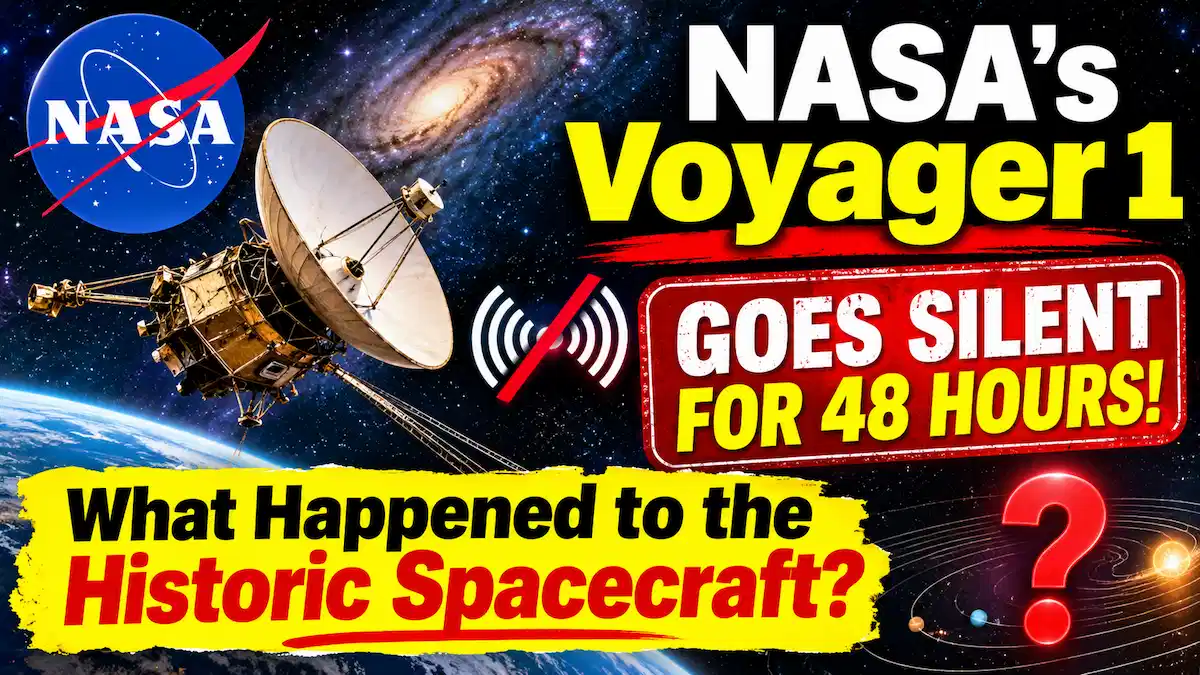
Although communication has since been restored, the unusual incident has raised fresh questions about the spacecraft’s ageing systems, declining power supply and how much longer humanity’s most distant explorer can continue its journey through interstellar space.
NASA’s Voyager 1 Suddenly Disappeared From NASA’s Radar
NASA’s Voyager 1 Voyager Voyager Deep Space Network failed to detect Voyager 1’s radio signal during two scheduled communication sessions on October 18 and October 19, 2026. The two attempts were separated by approximately 24 hours, but neither produced the expected signal.
The spacecraft was around 16 billion miles (24 billion kilometres) away from Earth when the communication problem occurred.
Fortunately, the situation improved on October 20, when Voyager 1’s signal suddenly returned. Even more interestingly, the spacecraft re-established communication before engineers had sent troubleshooting commands to resolve the issue.
NASA’s Voyager 1 confirmed that contact had been maintained since the signal returned, although engineers continued investigating what caused the unexpected interruption.
NASA’s Voyager 1 What Caused to Stop Communicating?
NASA’s Voyager 1 engineers have identified an unusual development involving Voyager 1’s thruster system.
One group of thrusters went offline, and the spacecraft automatically activated its backup thrusters. This behaviour appears to be connected to the spacecraft’s built-in fault protection system.
When onboard computers detect a possible problem, fault protection can move the spacecraft into a safer operating configuration and temporarily suspend normal activities. This gives engineers an opportunity to investigate the situation and decide what action is needed.
However, NASA’s Voyager 1 has not yet established the exact reason behind the thruster problem.
Voyager mission manager Kareem Badaruddin acknowledged that this was the first time the team had witnessed this particular behaviour. The incident highlighted the unpredictable challenges of operating such an old spacecraft at an extraordinary distance.
NASA’s Voyager 1 Big Bang Operation Is Helping Voyager 1 Survive
The communication interruption came shortly after NASA’s Voyager 1 completed an important energy-saving operation known as the “Big Bang” in September 2026.
During this operation, engineers switched off three power-consuming devices and replaced them with three lower-power alternatives. The complicated procedure was designed to reduce electricity consumption while maintaining the spacecraft’s temperature.
Voyager 1 depends on radioisotope thermoelectric generators, which produce electricity using heat from decaying plutonium.
However, the available power gradually decreases over time. NASA’s Voyager 1 estimates that the spacecraft loses approximately four watts of power every year.
Without these energy-saving measures, engineers expected to switch off another scientific instrument as early as summer 2027. The successful operation should allow Voyager 1 to continue collecting scientific information for longer.
NASA’s Voyager 1 Is Approaching a Historic One Light-Day Milestone
Despite its technical difficulties, Voyager 1 continues travelling farther into interstellar space.
Launched in 1977, the spacecraft has become the most distant human-made object from Earth. It crossed the heliosphere’s outer boundary in 2012 and entered interstellar space, where it continues studying the environment beyond the Sun’s protective influence.
NASA’s Voyager 1 expects Voyager 1 to reach approximately 16.09 billion miles (25.89 billion kilometres) from Earth on November 18, 2026.
This distance represents one light-day, meaning radio signals will take approximately 24 hours to travel in either direction. Sending a command and receiving a response could therefore require roughly two days.
The milestone demonstrates just how far human technology has travelled since the spacecraft’s launch nearly five decades ago.
NASA’s Voyager 1 How Much Longer Can NASA Keep N Alive?
Voyager 1 was originally designed for a much shorter mission, but its extraordinary durability has allowed it to continue operating for almost 49 years.
Its remaining scientific instruments are now essential because they provide information about interstellar space that no other operational spacecraft has directly collected.
NASA’s Voyager 1 engineers are carefully managing its limited power supply by shutting down selected systems when necessary. The team hopes to keep the spacecraft functioning for several more years, although its eventual shutdown is unavoidable.
For now, Voyager 1 is communicating again, and its journey continues. But the latest incident shows that every successful transmission from this distant explorer is becoming increasingly precious.
FAQs
1. Why did NASA lose contact with Voyager 1?
NASA lost contact with Voyager 1 during two scheduled communication sessions on October 18 and 19, 2026. The spacecraft's signal returned on October 20. Engineers identified a thruster system problem but had not established its exact cause.
2. Where is Voyager 1 currently located?
Voyager 1 is travelling through interstellar space, beyond the Sun's heliosphere. It is approximately 16 billion miles from Earth and remains the most distant human-made object.
3. How long will Voyager 1 continue working?
NASA hopes to keep Voyager 1 operating for several more years by conserving its declining power supply. However, its remaining lifespan depends on the condition of its ageing systems and the electricity available to support its scientific instruments.











Sudhanshu is the author of XYZ News Live and has over 2 years of experience in digital content writing. His focus is on presenting news and important information in a simple, clear, and accessible language for readers.
2 thoughts on “NASA’s Voyager 1 Sparks Fresh Panic After Going Silent for 48 Hours: What Happened to the Historic Spacecraft?”